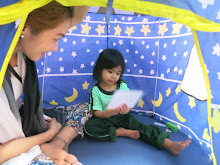
Monday, 23 January 2017

How To Raise Emotionally Intelligent Child

For more than three years being around with my toddler, it has been a heartache, pure bliss, anxiety, euphoria, and all whirlwind of emotions mixed up. I get a great sense of becoming my most human self.

I feel, I forgive, I apologize, I acknowledge, I accept, I welcome or embrace her childhood and sometimes when the need arises, I suck in whatever unnecessary emotions I need to just to show to my daughter how to take leadership on things that we sometimes don't need to complain about, things that she can't do just yet, things that she demand, or things that we needed to do.

I suck in all emotions just to take leadership that sometimes, the world does not revolve around her--eventhough she means the world to me. Within those sucking-in of emotions, she never knew how it sometimes breaks me all because I want to give the world to her. But I try to be honest as much as I can.

Within our times together, we celebrate expressing our emotions. I tend to sometimes exaggerate the feeling of excitement, joy, fun and happiness because that is my natural self, not ashamed to admit. I sing aloud, I dance, I jump, I express happy things deliberately and she sees it. So she copies me.

In times of tension between us, I apologize to her. When its her turn to upset me, she apologizes to me, without me asking for it.

Those are simple expressions of emotions that are vital for every child to understand. However, it doesn't just happen automatically. You as an adult should be able to model it to them until it comes out naturally from them, like apologizing.

What are the things that we need to remember in order for young children to develop emotional intelligence? Here are some tips that I believe were very helpful in raising my emotionally intelligent child:

1.) Storytelling. This is a very powerful habit that just brings about almost all important domains that we need to help the child uncover and discover. Expressing emotions is just one of them. You can take advantage of showing all forms of emotions when you deliver the story with whatever the charater in the story is depicting.

2.) Be Genuine. Expressing your emotions should be genuine. Young children are like dogs, they can sense tension and anxiety in you arising. If you feel upset or frustrated, do not fake it. It's okay to get upset or angry. However, express your anger in the manner on how you want your child to express them. If you can't help it, remove yourself from the situation.

3.) Name your emotions, verbalize. This is very effective. I talk it out when I am upset. I don't just sulk and keep quiet. My daughter has also mastered naming her feelings, whether she's excited, upset, angry or happy. Amazingly enough, everything else followed if she wants something, she verbalizes it openly, expresses what's in her heart openly. She even demonstrates them!

When its your turn to be upset, tell them the reason. In this way, you are teaching them to explain what makes them upset too. This saves you from becoming a fortune-teller and added stress, guessing why your child is acting up. My three year old can verbally express what makes her scared, worried, happy or upset.

4.) Be consistent. When you tell your child something, do it. Do not sway away. When it's no, then it is a no, yes when it is a yes.

5.) Forgive them for being a child. Young and older children 8years old and below need our warm guidance over and over again. They don't need our unnecessary comments on what they can not do. For example, if they forgot to keep their clothes on the laundry basket, you don't need to tell them how irresponsible they are, or be sarcastic and tell them "you are a big girl already, dont you still know what to do?" Instead, consider giving them comments like "I noticed you have not dropped your clothes at the laundry basket, please remember where to keep them after use."

6.) Acknowledge feelings. Don't panic when your child cries, gets angry or frustrated. There are times when children especially young ones cry out of frustration, and that's okay. Acknowledge by saying "you are crying because you want to go to the slide.."

Offer words of understanding like telling them "I understand why you are crying..", "I am here when you need to talk to me.."

7.) Forgive yourself for upsetting them. At this point, I still feel guilty at times for not being gentle to my toddler. I even feel bad and cry about not responding to her needs appropriately. You can never model self-regulation skills if you are too hard on yourself. We need release of our emotions and stress in order for us to lead them appropriately.

8.) Offer words of Empowerment. Have you seen those youtube vids of daddies empowering their little girls first thing in the morning? That is that! Perfect example on helping your child believe in herself/himself. Filling them with optimism makes a big difference.

However, empowering your children doesn't have to be overdone. When your child tries hard to climb on the ladder and is asking for your help, saying "you can do it!" as your ways to empower their spirit may unnecessarily create pressure than trying to empower them. When your child asks for your help, offering your hand is all they need, not your words.


Raising emotionally intelligent children needs leadership, warmth and respect. You do not always need to agree with your children, but you are also not invited to talk with sarcasm to them if you do not want them to be sarcastic to you.

The world has such a huge space to express your emotions, so be free, dance and sing when you can! But if it's not your personality to be that expressive, at least practice calmness, kindness and self-regulation.

Change yourself in order for your child to see that in you. You will never be able to see what you want to see from your child if you yourself dont bother how to interact appropriately to them.


In the end, nothing compares to embracing your child's weaknesses, faults and plainly being a child. The more we accept their vulnerabilities and acknowledge them, the better they connect to us and runs back to us when they become teenagers and adults, because we never judged their feelings when they were young. 


Happy Parenting!


Tuesday, 15 November 2016

Animal Sounds and Other What The Heck's in Early Childhood

This is not about being harsh to people who loves teaching animal sounds to young children. Just an observation and a quick spark of some questions while wandering off in the messy world of balancing realities and the not-so-real things seen on youtube.

I was watching a nursery rhyme video my daughter tapped from my phone. It's been quite sometime since we stopped watching those supposedly "educational" nursery rhyme vids you often see on youtube, since she has elevated to a more sensible things to watch from the laptop.

As I watched along with her, I couldnt help but contemplate on the dancing cow, swaying monkeys and other odd-looking movements of an animal. What exactly are these videos trying to convey to young children? Not to really challenge every science over everything, i just noticed and began to question myself, why the heck would a cow dance that way? Or a monkey sound that way, or a horse dance like some confused animal while producing the sound they "supposedly" make. 

As far as reality is concerned, I don't see the relation between trying to show a video of confused animals to enhancing whatever skills a child needs to enhance. Why do we even teach fake animal sounds to young children? 

I had no issues about these things, my daughter also watches those when she was really younger---and I do not exactly know why I let her watch confused animals. I don't try to evaluate everything, in fact this realization came only tonight..

I couldn't help but connect the idea as well on why do we let children, i mean toddlers, study shapes, colors, alphabets, numbers, forced to read, drilled with phonics, forced to write, etc...when there was no scientific study that these things are integral part on being a human being. Compared to looking deeply on what's essential, their socio-emotional intelligence and other skills every human being needs to "succeed" in this world.


As I watched the video and wandered off in the land of questions, I couldn't help but ask, how complicated have we made early childhood these days? Or do I rather ask, how quick do we replace real connection between children and real things with these non-sensical videos? Surely it is very entertaining, but these questions made me ask, why the heck would people want to project to young children a dancing cow, confused horse or an annoyed-looking monkey? 


Thursday, 27 October 2016

Teachable Moment: Respect and Resiliency

It was breakfast when my toddler requested to watch Alvin and The Chipmunks from her cousin's laptop. Her oldet cousins are aged 12, 11 and 8. All were way older than her.

Her cousins were still using the laptop. Her request was something that's not mine to control. Cousins were on their laptop and my little one wanted to watch the video. Hhmmm..she asked for the movie.

If I use my adult power, I can easily request it from them and ask them to give the little one a chance. But wait, what will I be teaching my toddler then? Will I be teaching her respect to other people if I oust her cousins in favor of her request? I don't think so.

So what I did instead was talk to my little one to ask her cousins if it's ok to watch the movie with them. She agreed. She went inside the room and asked her cousins politely. They agreed. They watched together. It was all good. I was happy. They were happy.

After a few minutes, my little one came to me again and said, "mommy, I want to watch here at the sala.." hhhhmmm... I told her, have you asked your cousins? She said yes. So I asked "what did they say?" She said, "they said, NO."

Alright. I thought what to do for awhile. While looking at her, I politely told her that the laptop does not belong to us and if they refuse to bring it to the sala, that means we respect what they say. She begged. "Mommy, please come to me and tell them...."

There goes her toddlehood agenda kicking in. I knew what she wanted me to do. But I stayed firm at telling her it is not our choice to decide. We respect what they say. The laptop is not ours and we cannot do anything about it. If you wish to still watch the movie, join them in the room and watch it there, I said.

She begged and got teary. I was a little anxious since I didn't ever want to turn her down. But I stayed calm and firm. I'm sorry my love, we can't force them.

She sat down with me while at the dining table and started to grab the Tarzan book within reach. She browsed the book and started to ask some questions. In my line of thought, I got relieved.

In early childhood education, there is this term we call "teachable moment." To quote, 

"A teachable moment is an unplanned opportunity that arises in the classroom where a teacher has an ideal chance to offer insight to his or her students. A teachable moment is not something that you can plan for; rather, it is a fleeting opportunity that must be sensed and seized by the teacher."

In this case, the teachable moment was not only for her, but for me. 

I thought, had I give in to her request in bringing the laptop at the sala ignoring her cousins refusal, I wouldn't be teaching her respect. 

I learned, when you take leadership in every situation your child is into, small conflict as this won't progress into bigger ones in the future. It was an opportunity for me, to stand my ground, teach my child about respecting other's decision and discipline my child in a non-threatening way. 

In children's world, it is not every parents' battle to intervene every single conflict they encounter with other children, neither our job to manipulate other children in favor of our own child's requests. Our role is to take leadership in guiding them how to respect other people's decisions.

 If in every conflict they are able to manage it on their own without adult intervention (unless it involves physical fights) , we are teaching them resiliency, which is another important life skills every child should practice. 


Happy parenting! 


Wednesday, 26 October 2016

Don't Worry, It's Okay.


Just before we finished our dinner, my toddler requested for a milo drink while I made my coffee on a cold rainy evening. She drank happily while I did my routine: finishing my meal and chatting to my mother.

She played and was happily running slowly around the house, to and fro. Sipping her milo once in awhile.

Then it happened. I didn't see it, but the milo splattered from the table! On to my bag, down to her books, the curtains and the floor.

She stood frozen. Looking at me intently after I carelessly reacted, " Naaaah!! See what happened?!" obviously in a disappointed manner, but never in a manner of yelling.

Without another word, I stood up and took the wipe from the kitchen. As I took the wipe, I reminded myself how she stood frozen, I reminded myself that it is just a splattered milo, and I reminded myself of my little girl's face, just a toddler who makes minor accidents at times, and that it is better not to say anything at the moment of my disappointment.

I wipped everything without saying anything while she was still there at the spot where her milo spilled.

While I was wiping, she blurted out these words to me:

"Don't worry, it's okay..."

What a reassuring phrase coming from my three year old. I am not only humbled, but I have learned yet again.


Everyday, I learn a thing or two from my toddler from the situations where we both are into. Sure my face was not compassionate at all, yet it was another good try to enhance my self-regulation skills, by not yelling, nagging or shouting.

After the cleaning up, I gently came to her and told her, next time it is best not to run inside the house. She then told me the reason why she ran, and said "tomorrow, I will not run anymore so I will not spill my milo."

No broken spirits, crying soul, negative energies. All was about learning self-regulation, out of a splattered milo.

One splattered milo at a time, one self-regulation learning at a time.

Happy Parenting!

Tuesday, 25 October 2016

I Kissed Co-Sleeping Goodbye (Lessons Learned)

I Kissed Co-Sleeping Goodbye (Lessons Learned)


I built a fairy-themed reading nook for my toddler inside our small-spaced room. I attached book holders on the side wall and decorated it with tool curtains. The succeeding week I thought of hanging a real small tree branch on the ceiling, right above her nook to give it a forest-like feel of hanging out with nature-creatures as she browse on her books, or do our storytelling sessions. I embellished it with some plastic leaves to complete the project. Finally, it was almost complete! 


That night, she laid her sleeping pillows on her “labored” reading nook as she comfortably experienced the area. It was sleeping time, I thought of helping her move her pillows to “our” shared bed across her nook. Surprisingly, she resisted politely. I asked her if she wants to sleep on her reading nook instead. She nodded.


I gladly accommodated her decision thinking that it could be just for that moment, while the lights were on at least. It didn’t dawn on me that it was the beginning. The beginning of the un-anticipated separation of sleeping-- for I don’t know how long, it could be until she becomes an adult. There were all those “threatening” elements happened that night that could presumably discourage her from sleeping on her own. There was mister loud thunder; lights were off, and it was her FIRST TIME to sleep without me literally by her side and so on. But she politely asked me to come beside her for awhile...(I said to myself, I knew it! she’d only going to ask US to “move” our sleeping area!)...but after softly asking me, this is what she said:


“You come to me for awhile mommy, but only for awhile...after that, you need to move back to YOUR bed until the thunder is gone....”

This is not happening now, please not yet. It was an overwhelming confused mixture of emotions that enveloped me. What have I done? What. Have. I. Done.


So much about how it started, there is something that I have learned here. My personal reflection of her having to successfully sleep through the night “away” from me without any traces of anxiety on her part was quite intriguing at the same time very reassuring for me. I was moved due to the fact that most kids her age can’t sleep without having to smell the scent of their parents before drifting away to their dreamland—which is what I now start to long for. This teaches me so much about giving the very essential life skill any child deserves. Let me share some thoughts before any of this amazing decision-making skill display happened. Consider reading the two important points my little girl has taught me.


Before my 3 year old toddler decided to sleep on her own, I learned that she has managed to build her: 


CONFIDENCE. This word is not as easy as how it looks. I’m even lost for words on how to put it as simple as possible. Okay here we go, when my daughter decided to sleep alone, I later realized it was not only about independence or her plain exploration on the new space. It was confidence. Where did it come from? In our daily interaction, she mostly enjoys “deciding” about little things on her own. How can she decide for herself when to bathe on her own? It was from the opportunities presented to her. It was when the opportunity was there, she grabbed her chance to try on her own, and I had to build that trust with her, that no matter how imperfect it would be, I trusted that she can do it. The relationship between building your trust to your child is very crucial in building their confidence in doing things on their own. It may happen on very small things, from choosing what cup to use down to respectfully listening to them when they say they are done eating. I had no idea these small things contributed to her making big moves such as sleeping “away” from me. 

Confidence is a very important life skill we can help our young children. I did not fully realize that building up their confidence come in small packages like those things I have aforementioned.  It only dawned on me the moment she decided to “leave” me, dang! That oozing confidence is just way too impressive!—trust me, it’s an unbiased opinion! :P


TRUST. This is something that is very hard to just give away to ANYBODY. But how can you trust yourself if the people around you initially do not trust you? This is a very sentimental issue for me. As the youngest, the earliest “mistrust” I encountered from my mother has never been forgotten. It is until now stuck in my head, that very moment, those specific choice of words, the way it was being said, the clothes I wore, the place where it happened and how it happened. It got stuck in me I guess because my mother was the very first person I expected would help me trust myself. But it didn’t happen. I was scarred for life after that. Let me share a quick story about it. 
One muddy morning, we had to leave for school. There were puddles everywhere. I was with my older sister on our way to school. My mom left a strict instruction to my sister, telling her:


Always watch out for your little sister, it’s muddy, AND SHE DOESN’T KNOW HOW TO AVOID THOSE PUDDLES.


Upon hearing those words, I felt terrible. I wanted to rebel. I didn’t want my sister to hold my hand. I wanted to show them that I can do it! That was the very sad emotion I felt that very instant. It may not have the same effect to others, but to me, it has shaken my core.


Based on that personal story, the instruction was very well-meant. Nothing so negative about telling my sister to watch over me. But those words did not mean well to help me build trust in myself. I felt INCAPABLE. I felt the very person whom I should gather strength from and belief in myself did not support me. I was 6 years old then.


This little toddler now, has managed to trust herself that she can do it, she is capable of sleeping alone. How come? Perhaps it was those series of encounters we have everyday that I carefully and mindfully choose what to say. The hardest let-go of my trust in her was when she actually asked me that she wants to bathe by HERSELF. ALONE. WITHOUT ME. I had to bite my tongue and not tell her that she can’t do it yet. I had to support her idea, her confidence by TRUSTING her. Had I robbed her from taking a bath by herself because she just can’t do it yet, I swear she’d feel exactly the same I felt when my mother didn’t trust me well. I did give trust a shot. It was very hard since bathing involves water—which we can associate to drowning and all sorts of horrible bathroom accidents. But there are a thousand ways to manage without sending them the message that they are incapable little beings. 


I did not despise my mother after that and I do not despise her now. It just so happened that it felt terrible not being trusted by the person you trust the most. Like I said, essential life skills come in small packages. Very simple daily encounters such as these can be a lifetime heartbreaker or could save your little from having trust issues about him/herself. So better be careful what to say and be mindful in choosing your words. 


Although trust is not necessarily an “active” verb, we can’t just say “good” things to them without showing our gestures that we do honestly trust them. We can’t tell them to “go on bathe by yourself, I trust you”, but then again, there you go obviously showing them that you are fidgeting with panic and fear drenched in cold sweats. What I’m saying is, when you say you trust them, at least show it to them that you really do. Young children are highly sensitive to body signals and physical gestures. 


Consider your colleague, your “trusted” friend, your boss or perhaps a loved one would challenge your capabilities by saying “hey, I think you can’t run that 5km dash marathon, you look heavy, your heart just can’t make it, you don’t look athletic, you just can’t make it..” Wouldn’t it feel insulting, making you gather all your guts by showing them all your skills, perhaps even back talking? Why? Because it just doesn’t feel right when people question your capabilities and simply show you they don’t trust you enough. That is a negative motivation.  It feels the same way for toddlers even babies! 

Instead of saying:

  • Stop climbing on the stairs; you don’t know how to use the stairs yet!
  • Don’t climb the window it will break your arms!
  • Stop playing inside the bathroom you might drown!
  • Let me tie your shoelace because you’re too slow.
  • Stop washing the dishes your hands are too small you might break it!


Consider saying:

  • I see you are interested on climbing the stairs, let’s go and explore it together!
  • I feel you love to use your muscle strength by climbing on the window, let me stand behind you in case you fall.
  • You love exploring the water don’t you? Let me fill the small basin for you. (If it’s not bathing time, you can always say firmly: I know it feels good to play with the water, but it’s not bathing time yet, how about we play fill-in-the-cups with water at the living room so we don’t get you soaked?)
  • Tying a shoelace feels interesting, but I think we are running late for our appointment, how about we do it together for now?
  • Washing dishes is a wonderful house chore, can we do it together?


Trust does not necessarily have to be torturous for us, parents or caregivers. When things are a bit too risky for them to even try, you can always offer words that don’t necessarily make them think less about their own capabilities. Young children are capable beings who need constant guidance from the adults around them, not constant rants that would make them question their own capabilities, thus leaving them always anxious and untrusting about their own self. 


If it seems very difficult for you to let-go of your trust, at least do not let your child hear it from you.


My little girl has taught me how trust is built. It was a process that didn’t naturally occur to me. Her eagerness and physically active toddlerhood taught me how to let go and trust in her. Her wishes pushed me to stop being so hyper-protective when she wanted to climb our window grills. She has taught me to stop worrying when she runs freely on a vast grassy ground. There were so many missed moments I did not trust her so well, I regret it. But I have learned.  


Along with my motherhood journey, is her daddy, who made a colossal impact of letting go with my trust issues to our daughter and simply showed me how to fully trust our little tot. He has shown me, that allowing our child ride a toy car by herself has liberated our daughter with the strong feeling of confidence, independence and strong sense of self-trust at that moment. I give my husband the full credit at being better in providing our daughter a strong dose of taking bold risks. I’ am still working at it though, but with the results I have seen so far, I can only get better. One confidence and trust-building at a time, one growing confident and self-trusting toddler!


Sometimes, it is not just about mere common sense when we are raising children, especially young kids. It looks as easy as that, but if you come face to face with a young child, you are also faced with a lot of questions in your mind on how to properly address some issues that's why parenting blogs and other parenting articles are created for parents who are at their wits ends and when all common sense has left you somewhere.


CONFIDENCE AND TRUST, two most important life lessons I have learned....when I kissed co-sleeping goodbye....

Sunday, 18 September 2016

When Defiance Strikes


It is not surprising when our toddlers show defiant behaviors towards us or to their primary caregivers.
Oftentimes, we get a surprise of our parenting lives when we notice them being so gentle, kind, sweet, loving and super cutie when they are in school or perhaps during play visits. When in fact at home, they turn into little demons running around, screaming, yelling, rolling on the floor, or to simply put it, possessed by a power-hungry devil in a toddler's body. Sometimes too, it's the other way around. They are quiet at home, but little brats in school. Why do these things happen? Unfortunately, it does happen, and our reponses to these behaviors matters a lot.

You may sound silly talking to a month old infant, but establishing and investing a connection even for a week old infant makes them feel they are being accepted and acknowledged, despite their lack of verbal skills. This connection will bear fruit as your child grows everyday.

Recently, my newly-turned three year old toddler showed some of these behaviors (minus those horrifying floor-rolling)  I knew she's going to get into that phase too, but even as I have known it, I never thought I was that ready to face the struggle. Gladly enough, as weeks progressed, she became "normal" again. Now, even more sweet, confident and empathic little toddler.

The trick is, she did not get back to "normal." She was displaying what is "normal" in every child. Her "defiance" did not progress because I made her feel she was accepted and acknowledged, and I guide her through how to properly express things, and when it is impossible for her to express things appropriately just yet, it is okay, there is always another try next time. There were plenty of times she keeps saying NO when I wanted to hear some YES, but instead of me insisting on what needs to be done, I stay calm and ask her questions why isn't she doing it yet. From there, we work on what works!

The question though is, is she really being defiant? When I gently remind her about bathing time, before I even finish my sentence, she automatically say NO. I didnt know they are programmed for an autoresponse! It is always a NO when you wish to get their YES, and a YES when you wish to hear a NO.

What is DEFIANT (Adj.) anyway? Based on Merriam-Webster dictionary, it means "refusing to obey something or someone." To clear the waters, when I was telling my daughter it was eating time and she needs to put her toys down first, her autoresponse was a big, solid NO. Was she being defiant? YES.

Let's take a little stroll in the park. How do we view this defiance? As an adult, do we also automatically view it as something BAD? Like toddlers, do we also have this (preprogrammed mindset) AUTOMATIC association to their defiance as something that NEEDS TO BE STRICTLY CORRECTED or FIXED? Or do we try to accept any flaw any human being is prone to do, and perhaps see it as an opportunity from our side to model appropriate responses? If you are that "traditional" parent, I bet every disagreement you get from your toddler equates to spanking, timeouts, or other corporal punishments. But if you are that respectful and empathic parent, you'd probably try to turn the tables around first, and see this as your own "teachable moment" to keep yourself composed, self-regulated, empathic parent and see how you both work around the issue.

 Taking from my own child's simple defiance in eating, I always get a NO in every invitation for mealtime from her. But do I make a big fuss out of it? NO. I don't yell at her because I still don't get a YES from her since, I don't drag her to the table, I don't need to even strap her around the high chair. WHY? Here are simple reasons:

1.) She's THREE and I'm THIRTY-THREE. I'm a three decade and three years older than her, I don't take her NO or YES personally. Is it a struggle? YES, because I never knew this is how hard a long-term courtship is! My daughter is indeed very hard to get!!! I'm courting her everyday for free meals! Damn, I cant get a yes! Like a suitor, do I act-up? NO, she might never give me a YES all the more! I need to guard my emotions and NEVER GIVE UP! That's the spirit! Never give up on your age and size. We are bigger than them therefore our size is already (inevitably) an intimidating power over them, so naturally their NEED to disagree with us oftentimes is like breathing for them and it's completely healthy and normal. In other words, just don't take every disagreement personally. It is really just a non-threatening YES or NO, so don't sweat.

2.) For a simple "NO Mommy, I'm still playing" response from ALL of my eating invitation, my toddler knows how to express. She is being defiant and that is honestly healthy, I'm happy. What about discipline? She's three and I believe, my child is not yet READY to sit that long to finish a full meal with me on the table. Plus, in my family, there is only me and her for now, it is not actually our ritual to eat "together" with just the two of us. She doesn't join me eating, I go sit with her playing while eating. What's the big deal? NOTHING. What about forming the habit? I'd say, it's still about readiness. So don't sweat on forcing too hard on something your toddler is not ready yet. By 5, she'll learn to sit down and practice table manners, or as long as she's ready, who knows it might be tomorrow!

3.) She might be meaning something else behind every NO's and YESes. The hundred languages of children. They could say a lot of things but that doesn't necessarily what they always mean. It could mean:
*Please, mommy not now.
*I still feel full mommy.
*I don't feel like eating just yet, mommy.

and list goes on. Sometimes or most of the time, kids learn to hate because adults keep forcing them. So relax and stop being so stern and rigid on expecting the same thing every day of your life with a toddler. Rather, I suggest, take these times as "teachable moment" for yourself on practicing self-regulation skills, how calm and loving can you be despite the sudden change in today's life with your toddler.


4.) Just know that a NO is a sign of a strong-willed, self-confident child! They mostly disagree because they are in their comfort zones. They know that even when they disagree with us, we still love them! But when they are in an unfamiliar place and people,they mostly just follow, because more often than not, they are unsure how the stranger would take their disagreeing behavior. For them, it's better to stay safe and follow than to show their true colors and suffer for the "unknown" and unpredictable reactions of that stranger. So be happy they are being defiant in your house, that means they are comfortable to show who they really are. They feel welcomed no matter how they scream, but that doesn't mean that you stop guiding their unpleasant behaviour.

The catch is, no matter how comfortable they are at showing their real self, that is not a reason for you to let their unpleasant behavior rule. Take this as a moment to teach yourself on how to respectfully respond to your child in times of challenging behavior.

You may respectfully respond to them by:

* Keeping your cool.


*Talk to them and acknowledge what they feel by saying, "You threw the cup because you were upset," "You started screaming because you wanted to say something, I hear you now, tell me what do you want to say.."
*Stay with your child for a moment, any chore can wait.
*It helps to be quiet at times when your child seems to be very upset and is impossible to touch him. But let him know you are there to listen when he is done expressing his frustrations. Make sure you are still there when he is done. Do not ignore. There is always a time to talk.
* You have all the reasons to say that you are SORRY. If it was really you that scared, or made your child upset. It happens to me all the time. When I can't help it, sometimes I raise my voice to emphasize what Im saying. She gets scared, run away and cry (because she is not used to hearing me really seriously raise my voice). I always take this as an opportunity for me to say "I'm sorry," not because I did not allow her to throw marbles on the vase, but because I scared her. There is big a difference.

Being apologetic is very respectful, teaching them how to say "sorry" is more authentauthentic than telling  them when to do it.

5.) Defiance is not always what it seems, it may be just the tip of an iceberg. It may pose as a challenge for every parent to correct every single defiant behavior, but it is not always what it seems. Behind every defiance lies a need. A need for the adult to help the child uncover, they cannot uncover it themselves, that's why we are there to parent them. Sometimes, it needs a warm acceptance, not a strict correction or fix. If they refuse to obey:

*kneel down to their level and let them feel you are listening. Ask why.
*Allow them to talk and establish a trusting relationship that you are there willing to accept whatever it is that they say. You will see the difference if you learn to listen to what they say, from there, work around on something that works best.
* If the defiance is strong enough, emphasize what you need to while you respectfully take leadership in doing what needs to be done. "I'm sorry honey, we need to get dressed because we are going to be late.."  In this situation, it won't help to yell, or scream at your child. We all at times need to rush, but taking leadership and in charge of every situation always win the game.

If you are a new parent, or a struggling one, it wouldn't hurt to SEEK HELP from informed people, whom you feel comfortable enough to open up about your concerns regarding young children. It is a lifetime investment acquiring knowledge on how to raise your young with full trust, love and respect.

 Our responsibility is not only about giving them food, sending them to school. It is our responsibility to educate ourselves and learn what needs to be done to properly NURTURE them.

Oftentimes, I can't help but question the lack of sensitivity among parents when it comes to seeking help in educating themselves. I question every inch of them when they have already seen the "damage" in their own child. We always would get an answer of, their parents didnt know how, their parents were unaware how to lovingly raise..their parents, their parents....then why do we allow to be left "uneducated" in raising young kids? Why are we so bothered in sending our kids to school that we tend to overlook the very essential thing we need in life-- human relations, we seem to lack a LOT of it. Then when our child becomes defiant --- we question other people. It's time to look at ourselves. Time to see how have we been raising our young?

In my very well-intentioned entry, I hope parents will see the urgency of educating themselves. I have seen news all around kids stabbing their teacher and all other murderous act. Can they blame their teacher for pushing them to their limits? Can they blame anyone for doing such heinous crimes? I think the question will always point you back on "how were you raised as a child...."


Defiance is not just a phase when it has been there persistently for years. Defiance is something that needs to be addressed. When defiance goes on until adolescent, a series of personality disorders is waiting at their door. Fixing it only at that time may be possible, but why fix something later in life when you can always do something in their early years?

Happy Parenting!


Sunday, 28 August 2016

Toddler Readiness Matters


Today marked my sweetcakes' 5th day bathing by herself. It's bittersweet. She has her own independence now, practiced at its best. I waited until the fifth day to somehow "rejoice" in the sense that it made my motherhood days felt the sense of fulfilment. Another milestone marked on the walls of my heart. I waited for the fifth day as well to see the consistency when she decided to bathe by herself..indeed, she consistently chose to do it by herself, at her age of three.

It was Monday when all of a sudden she told me, "Mommy, I want to bathe by myself." It was quite surprising for me to hear that, as our routine is always the two of us in the shower. But that day, she asked for it. I let her. Of course with close supervision.

The first day, I couldn't help but kept peeping at her by the slightly opened door, a curious mom would be doing the same thing I did, for safety and of course, just being sneaky. From outside, I asked her if she has put soap on her arms, armpits, legs, etc. she replied, "not yet mommy" so I waited..in less than a minute, I saw her small hand reaching for the soap. I beamed with a mixed feeling. She's not a baby anymore.

I tried, with all my sneaky moves to peep again, but she caught me! She pushed the door and emphasized, "Don't see my p*p*!" I hurriedly answered back, "I'm just checking for the soap!" Outside the toilet door, I realized she really meant it when she said she wanted to do it on her own, I can no longer interrupt (though not strictly as I still have to double check on her inside), I need to respect her "privacy."

When she was done bathing, I excitedly wrapped her with the towel and asked her how it went. But she moved away from me and said "Don't wipe me! I want to wipe myself" Quite ridiculous this independence thing! I just don't know how much I actually like it! It's robbing my time with my baby! Power struggle, eh?! Nah, not really. I am giving her all the space she needs.

I used to hold her in my arms, cup her face with my big hands, lather her with soap and play bubbles together, wipe her dry...but I don't think I still have so much of that after her consistent 5days self-bathing. She's practiced so much independence eversince she realized she can do it on her own, right before I even realized it.

And on her fifth day, she asked to brush her teeth, by herself. That is something I cannot allow just yet. She asked for it in fact even before, but she would calmly surrender by taking turns, she does it by herself first, then she I would brush her after her turn. That's what I also did today, though quite a struggle, since she wouldn't let go of the toothbrush! Well, this time, I surrendered, gave her the opportunity to do it. Yet, we still ended with my turn.

Then again, I wanted so much more. More of our bathing moments together. How come she suddenly didn't want me in? Is this the same feeling I'd feel when she wouldn't want me to play with her anymore? When she would no longer feel the need to call me for bedtime? Ask for milk, read aloud to her, or maybe hug her...? It is big deal for me, after all, I have spent almost all of my days for three years with her. Now this. Independence would just freely take it away from me. Not a good feeling.

On a positive light, this situation is one good example that children, as young as three years old, are capable of doing things, BUT, it has so much to do with readiness and providing opportunities for them to practice the needed skills in life. Readiness, in all sorts of every child's life, be it about sitting,rolling, walking and the list goes on. As for me, I am so guilty for walking my baby when she was only less than 12 months and at that time, my sweetcakes was not really trying to navigate a lot on her own, it was quite pushy on my part to walk her...only I found out later about the importance of readiness and how parents should respect their child's developmental readiness and rather, be patient, wait and be surprised!

It doesn't matter whether your child learns to shower later than 3, in fact it is nothing standard. What matters is, whenever they ask to do something on their own, do not deny them the chance to learn things on their own as long as it is far from tearing their bones apart. Be there to simply make them feel they can do it, build their confidence.

What did I learn about my child's readiness for self-bathing? I learned that a child can always do something ONLY when they are ready. That is true with the rest of every child's developmental milestones as well. They know what they are capable of doing and they will always do things anyway no matter how risky we think it is. But isn't it important too that our children need to see it from us that we believe in them? Had I stopped her from bathing herself-- because my paranoia is just around the corner-- would it be more damaging to her self-confidence that I, as her mother, is not trusting her? I have learned that, allowing my child to try it on her own, I am giving her a gift of a lifetime -- belief in herself that she can do it no matter how imperfect it is on her first tries. She did it, anyway.


Happy parenting!